Buy validcc.eu ?
We are moving the project
validcc.eu .
Are you interested in purchasing the domain
validcc.eu ?
domain@kv-gmbh.de · 0541-91531010
Buy validcc.eu ?
Where can one buy a 3-liter Brut Imperial Champagne from an old collection?
You can buy a 3-liter Brut Imperial Champagne from an old collection at specialty wine shops, high-end liquor stores, or through online retailers that specialize in rare and collectible wines. You may also find such a bottle at auctions or through private collectors who are willing to sell from their personal collections. It's important to do thorough research and possibly seek the assistance of a wine expert to ensure the authenticity and quality of the bottle before making a purchase. **
How long does a Chardonnay Brut last?
Chardonnay Brut typically has a shelf life of 3-5 years if stored properly. It is best enjoyed within the first 1-2 years to fully appreciate its fresh and fruity flavors. However, some higher quality Chardonnay Brut wines can age gracefully for up to 5 years, developing more complex and toasty characteristics. It is important to store the wine in a cool, dark place and away from any strong odors to ensure it lasts as long as possible. **


Similar search terms for Champagne-Brut-Blason-d
Top-Angebote
Products related to Champagne-Brut-Blason-d:
-
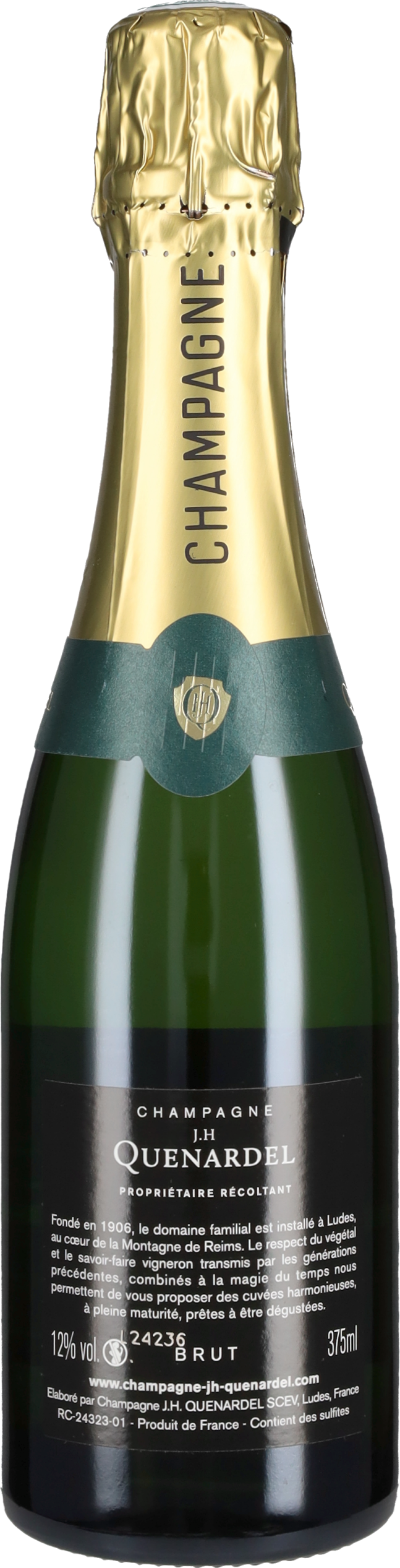
Champagne Brut 'Blason Vert' Quenardel - 37.5clThe Champagne Brut ‘Blason Vert’ from the champenoise reality J.H Quenardel is characterized as a sparkling wine with a classic and balanced style that serves as a sort of business card for the winery. Founded back in 1906 by Henri Quenardel, grandfather of the current owner and namesake Henri Quenardel, the J.H Quenardel winery has experienced constant qualitative and quantitative growth over its more than 100 years of history. Today, the Quenardel family manages 18 hectares of vineyards spread across the Montagne de Reims, with the winery located in the small village of Ludes.J.H Quenardel ‘Blason Vert’ Champagne Brut comes from a blend of Chardonnay (47%), Pinot Noir (38%), and Pinot Meunier (15%) grapes cultivated using sustainable agronomic practices, as evidenced by the ‘VDC’ and ‘HVE’ certifications. In particular, both Pinot Noir and Pinot Meunier come from villages in Champagne classified as Premier Cru. After harvesting, the grapes are transferred to the winery and vinified in white through gentle pressing and alcoholic fermentation in stainless steel tanks. Once ready, the base Sparkling wine is then bottled with the addition of liqueur de tirage for refermentation according to the prestigious Méthode Champenoise. This is followed by a long aging of at least 36 months on the lees, after which the degorgement and final dosage are carried out as Brut, at 7.8 g/l of residual sugars. Specifically, for the liqueur d’expedition, a base of perpetual reserve from Chardonnay grapes is used.The ‘Blason Vert’ Champagne Brut by J.H Quenardel has a straw yellow color with greenish reflections and a rich, persistent, and very elegant effervescence. Fruity aromas of rhubarb and gooseberry characterize the nose, enhanced by intense citrus notes that anticipate the slightly spicy finish, where notes of toasted bread emerge accompanied by mineral sensations of flint. The sip is luscious, very lively, with a full body that does not, however, prelude to the overall dynamism and delicacy.27,00 £*Shipping: 48,00 £Secure redirect to the provider
-
Champagne Rosé Brut 'Blason Rouge' QuenardelThe Champagne Brut Rosé ‘Blason Rouge’ is a Champagne with a fruity and gastronomic dimension, produced in the Montagne de Reims by the family-run business J.H Quenardel. Unlike in Italy, where rosé wines are produced differently, Champagne Rosé is traditionally made by adding red wine, made from Pinot Noir and/or Pinot Meunier grapes, to a base of white wine, which can be obtained from white grapes like Chardonnay or from black grape varieties vinified as white.The ‘Blason Rouge’ Champagne Rosé Brut by J.H Quenardel is produced from a blend of Chardonnay grapes (50%), Pinot Noir (40%), and Pinot Meunier (10%), cultivated in an environmentally friendly manner, as evidenced by the ‘VDC’ and ‘HVE’ certifications. After the harvest, the grapes for the white wine base are transferred to the winery for soft pressing, followed by the alcoholic fermentation of the must in stainless steel tanks. The resulting wine is then supplemented with 35% vin de reserve and 10% of Pinot Noir vinified as red, in order to obtain the rosé color. The resulting sparkling base is then bottled with the addition of liqueur de tirage for bottle fermentation according to the Champenoise Method, associated with at least 24 months of aging on the lees. The sparkling wine is finally subjected to degorgement and subsequent dosage Brut, with 7.8 g/l of residual sugars. In particular, the liqueur d’expedition used is made from a perpetual reserve of Chardonnay grapes.The color of the J.H Quenardel ‘Blason Rouge’ Brut Rosé Champagne is a pale and bright pink with fine and abundant effervescence. The nose is described by notes of red fruits like ripe cherry and raspberry, combined with hints of minerals and delicate spicy notes of cinnamon and vanilla. Very fresh and delicious on the palate, characterized by good balance and elegant softness.62,00 £*Shipping: 48,00 £Secure redirect to the provider
-
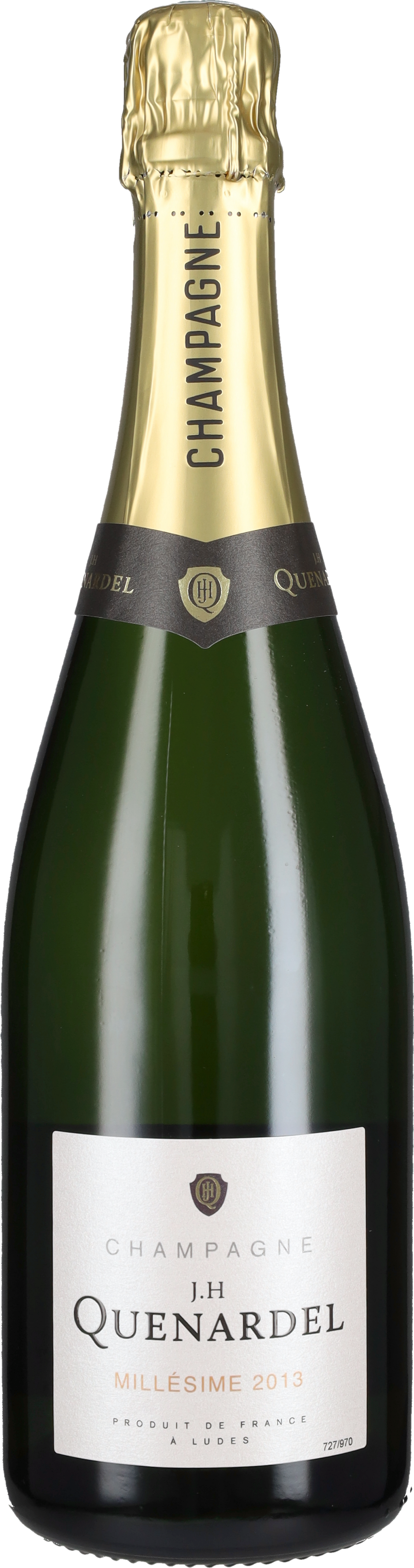
Champagne Brut 'Blason d'Or' Millesime Quenardel 2013The sparkling house J.H Quenardel presents the Champagne ‘Blason d’Or’ Brut Millesime, a prestigious and complex sparkling wine, resulting from the most classic of champenoise blends. This vintage Champagne, one of the flagship products of J.H Quenardel, is produced exclusively in the best years, when the climatic conditions of the season allow for the obtaining of superior quality grapes.The ‘Blason d’Or’ Champagne J.H Quenardel Brut Millesime is made from the classic blend of Chardonnay grapes (45%), Pinot Noir (40%), and Pinot Meunier (15%), varieties cultivated using sustainable practices certified by ‘VDC’ and ‘HVE’. Once harvested, the grapes from the single vintage are taken to the winery for white winemaking with soft pressing and alcoholic fermentation of the must in stainless steel tanks. The second fermentation takes place in the bottle thanks to the addition of liqueur de tirage to the sparkling base, in accordance with the fine Champenoise Method. The aging sur lattes lasts over 60 months, at the end of which the disgorgement and the dosage Brut at 6.5 g/l of residual sugars is carried out. In particular, a perpetual reserve base from Chardonnay grapes is used in the liqueur d’expedition .The Champagne Brut Millesime ‘Blason d’Or’ by J.H Quenardel has a straw yellow color with golden reflections from the very fine perlage. The aromatic bouquet consists of broad fruity aromas of peach, green apple, apricot, and pear that meet sweet hints of honey and notes of orange blossom and brioche. On the palate, it is intense and balanced, with great expressiveness, featuring a taut fresh-salty progression that rests on a rich mineral finish, where elegant sensations of toasted bread and almond emerge.94,00 £*Shipping: 48,00 £Secure redirect to the provider
-
Champagne Demi-Sec 'Blason Vert' QuenardelThe Demi-Sec Champagne ‘Blason Vert’ from the champenoise house J.H Quenardel is a slightly sweet sparkling wine that stands out for its softness and fragrance. The Demi-Sec Champagne category identifies those sparkling wines produced in Champagne with a sugar residue between 32 and 50 g/l, sufficient to create a well-perceived sweetness that remains balanced and not at all cloying. Due to this never excessive sweetness, these Champagnes can be enjoyed both as an aperitif, perhaps paired with various cheeses, and at the end of a meal, accompanied by dry pastries or seasonal fruit.The Demi-Sec Champagne ‘Blason Vert’ by J.H Quenardel originates from a blend of Chardonnay (47%), Pinot Noir (38%), and Pinot Meunier (15%), varieties cultivated with respect for the environment, as demonstrated by the ‘VDC’ and ‘HVE’ certifications. In particular, both Pinot Noir and Pinot Meunier come from Champagne villages classified as Premier Cru. Once harvested, the grapes are transferred to the cellar and vinified in white through soft pressing and alcoholic fermentation in stainless steel tanks. The53,00 £*Shipping: 48,00 £Secure redirect to the provider


-
Can champagne expire?
Champagne does not necessarily expire in the same way that food or other perishable items do. However, it can lose its flavor and quality over time if not stored properly. Champagne should be stored in a cool, dark place and kept away from temperature fluctuations and light exposure. If stored correctly, champagne can last for several years and even improve in flavor with age. **
-
What does "Brut des Teufels" mean in a dream?
"Brut des Teufels" is a German phrase that translates to "Devil's brood" in English. In a dream, this phrase could symbolize feelings of fear, danger, or the presence of evil forces. It may represent inner turmoil, negative influences, or a sense of being overwhelmed by dark emotions or experiences. It could also suggest a need to confront and overcome negative aspects of oneself or external challenges. **
-
Do D/D/D monsters count as D/D monsters?
Yes, D/D/D monsters do count as D/D monsters. D/D/D monsters are a subgroup within the larger D/D archetype, so they share the same naming convention and are considered part of the D/D family. This means that cards or effects that specifically refer to D/D monsters would also apply to D/D/D monsters. **
-
Can champagne go bad?
Yes, champagne can go bad if it is not stored properly. Exposure to light, heat, or fluctuations in temperature can cause champagne to spoil. Additionally, if the cork is not sealed tightly or if the bottle is stored upright, the champagne can oxidize and lose its flavor. It is best to store champagne in a cool, dark place on its side to keep it fresh for longer. **

What percentage is the champagne glass on the left filled, when the champagne...
The champagne glass on the left is filled to approximately 60% when the champagne is poured to the level shown in the image. This estimation is based on the visual representation of the glass and the amount of champagne in it. The glass appears to be filled just over halfway, indicating that it is around 60% full. **
Which champagne is the sweetest?
The sweetest type of champagne is typically labeled as "demi-sec." Demi-sec champagnes have a higher sugar content compared to other varieties like brut or extra brut. These champagnes are known for their sweeter taste profile, making them a popular choice for those who prefer a dessert-like champagne. **
Top-Angebote
Products related to Champagne-Brut-Blason-d:
-
Champagne Brut 'Blason Vert' QuenardelThe Champagne Brut ‘Blason Vert’ from the champenoise J.H Quenardel is characterized as a sparkling wine with a classic and balanced style that serves as a sort of business card for the winery. Founded back in 1906 by Henri Quenardel, grandfather of the current owner and namesake Henri Quenardel, the J.H Quenardel winery has experienced constant qualitative and quantitative growth over its more than 100 years of history. Today, the Quenardel family manages 18 hectares of vineyards distributed in the Montagne de Reims, with the winery located in the small village of Ludes.J.H Quenardel ‘Blason Vert’ Champagne Brut comes from a blend of Chardonnay (47%), Pinot Noir (38%), and Pinot Meunier (15%) grapes cultivated using sustainable agronomic practices, as evidenced by the ‘VDC’ and ‘HVE’ certifications. In particular, both the Pinot Noir and the Pinot Meunier come from Champagne villages classified as Premier Cru. After harvesting, the grapes are transferred to the winery and vinified in white through soft pressing and alcoholic fermentation in stainless steel tanks. Once ready, the base The sparkling wine is then bottled with the addition of liqueur de tirage for refermentation according to the prestigious Méthode Champenoise. It follows a long aging of at least 36 months on the lees, after which the degorgement and final dosage as Brut, at 7.8 g/l of residual sugars, are carried out. Specifically, for the liqueur d’expedition, a base of perpetual reserve from Chardonnay grapes is used.The ‘Blason Vert’ Champagne Brut by J.H Quenardel has a straw-yellow hue with greenish reflections, featuring a rich, persistent, and very elegant effervescence. Fruity aromas of rhubarb and gooseberry characterize the nose, enhanced by intense citrus notes that anticipate a slightly spicy finish, in which notes of toasted bread emerge accompanied by mineral sensations of flint. The sip is luscious, very lively, with a full body that does not, however, preclude overall dynamism and delicacy.55,00 £*Shipping: 48,00 £Secure redirect to the provider
-
Champagne Brut 'Blason Vert' Magnum QuenardelThe Champagne Brut ‘Blason Vert’ from the champenoise reality J.H Quenardel is characterized as a sparkling wine with a classic and balanced style that serves as a sort of business card for the winery. Founded back in 1906 by Henri Quenardel, grandfather of the current owner and namesake Henri Quenardel, the J.H Quenardel winery has experienced constant qualitative and quantitative growth over its more than 100 years of history. Today, the Quenardel family manages 18 hectares of vineyards spread across the Montagne de Reims, with the winery located in the small village of Ludes.J.H Quenardel ‘Blason Vert’ Champagne Brut comes from a blend of Chardonnay (47%), Pinot Noir (38%), and Pinot Meunier (15%) grapes grown using sustainable agronomic practices, as evidenced by the ‘VDC’ and ‘HVE’ certifications. In particular, both the Pinot Noir and Pinot Meunier come from villages in Champagne classified as Premier Cru. After harvesting, the grapes are transferred to the winery and vinified in white through soft pressing and alcoholic fermentation in stainless steel tanks. Once ready, the base sparkling wine is then bottled with the addition of liqueur de tirage for refermentation according to the fine Champenoise Method. This is followed by a long aging of at least 36 months on the lees, after which the degorgement and final dosage as Brut, at 7.8 g/l of residual sugars, are carried out. Specifically, for the liqueur d’expedition, a base of perpetual reserve from Chardonnay grapes is used.The ‘Blason Vert’ Champagne Brut by J.H Quenardel has a straw yellow color with greenish reflections, rich, persistent, and very elegant effervescence. Fruity aromas of rhubarb and gooseberry characterize the nose, enhanced by intense citrus notes that anticipate the slightly spicy finish, in which notes of toasted bread emerge accompanied by mineral sensations of flint. The sip is delicious, very lively, with a full body that does not, however, foreshadow the overall dynamism and delicacy.106,00 £*Shipping: 48,00 £Secure redirect to the provider
-
Champagne Brut 'Blason Vert' Quenardel - 37.5clThe Champagne Brut ‘Blason Vert’ from the champenoise reality J.H Quenardel is characterized as a sparkling wine with a classic and balanced style that serves as a sort of business card for the winery. Founded back in 1906 by Henri Quenardel, grandfather of the current owner and namesake Henri Quenardel, the J.H Quenardel winery has experienced constant qualitative and quantitative growth over its more than 100 years of history. Today, the Quenardel family manages 18 hectares of vineyards spread across the Montagne de Reims, with the winery located in the small village of Ludes.J.H Quenardel ‘Blason Vert’ Champagne Brut comes from a blend of Chardonnay (47%), Pinot Noir (38%), and Pinot Meunier (15%) grapes cultivated using sustainable agronomic practices, as evidenced by the ‘VDC’ and ‘HVE’ certifications. In particular, both Pinot Noir and Pinot Meunier come from villages in Champagne classified as Premier Cru. After harvesting, the grapes are transferred to the winery and vinified in white through gentle pressing and alcoholic fermentation in stainless steel tanks. Once ready, the base Sparkling wine is then bottled with the addition of liqueur de tirage for refermentation according to the prestigious Méthode Champenoise. This is followed by a long aging of at least 36 months on the lees, after which the degorgement and final dosage are carried out as Brut, at 7.8 g/l of residual sugars. Specifically, for the liqueur d’expedition, a base of perpetual reserve from Chardonnay grapes is used.The ‘Blason Vert’ Champagne Brut by J.H Quenardel has a straw yellow color with greenish reflections and a rich, persistent, and very elegant effervescence. Fruity aromas of rhubarb and gooseberry characterize the nose, enhanced by intense citrus notes that anticipate the slightly spicy finish, where notes of toasted bread emerge accompanied by mineral sensations of flint. The sip is luscious, very lively, with a full body that does not, however, prelude to the overall dynamism and delicacy.27,00 £*Shipping: 48,00 £Secure redirect to the provider
-
Champagne Rosé Brut 'Blason Rouge' QuenardelThe Champagne Brut Rosé ‘Blason Rouge’ is a Champagne with a fruity and gastronomic dimension, produced in the Montagne de Reims by the family-run business J.H Quenardel. Unlike in Italy, where rosé wines are produced differently, Champagne Rosé is traditionally made by adding red wine, made from Pinot Noir and/or Pinot Meunier grapes, to a base of white wine, which can be obtained from white grapes like Chardonnay or from black grape varieties vinified as white.The ‘Blason Rouge’ Champagne Rosé Brut by J.H Quenardel is produced from a blend of Chardonnay grapes (50%), Pinot Noir (40%), and Pinot Meunier (10%), cultivated in an environmentally friendly manner, as evidenced by the ‘VDC’ and ‘HVE’ certifications. After the harvest, the grapes for the white wine base are transferred to the winery for soft pressing, followed by the alcoholic fermentation of the must in stainless steel tanks. The resulting wine is then supplemented with 35% vin de reserve and 10% of Pinot Noir vinified as red, in order to obtain the rosé color. The resulting sparkling base is then bottled with the addition of liqueur de tirage for bottle fermentation according to the Champenoise Method, associated with at least 24 months of aging on the lees. The sparkling wine is finally subjected to degorgement and subsequent dosage Brut, with 7.8 g/l of residual sugars. In particular, the liqueur d’expedition used is made from a perpetual reserve of Chardonnay grapes.The color of the J.H Quenardel ‘Blason Rouge’ Brut Rosé Champagne is a pale and bright pink with fine and abundant effervescence. The nose is described by notes of red fruits like ripe cherry and raspberry, combined with hints of minerals and delicate spicy notes of cinnamon and vanilla. Very fresh and delicious on the palate, characterized by good balance and elegant softness.62,00 £*Shipping: 48,00 £Secure redirect to the provider
-
Where can one buy a 3-liter Brut Imperial Champagne from an old collection?
You can buy a 3-liter Brut Imperial Champagne from an old collection at specialty wine shops, high-end liquor stores, or through online retailers that specialize in rare and collectible wines. You may also find such a bottle at auctions or through private collectors who are willing to sell from their personal collections. It's important to do thorough research and possibly seek the assistance of a wine expert to ensure the authenticity and quality of the bottle before making a purchase. **
-
How long does a Chardonnay Brut last?
Chardonnay Brut typically has a shelf life of 3-5 years if stored properly. It is best enjoyed within the first 1-2 years to fully appreciate its fresh and fruity flavors. However, some higher quality Chardonnay Brut wines can age gracefully for up to 5 years, developing more complex and toasty characteristics. It is important to store the wine in a cool, dark place and away from any strong odors to ensure it lasts as long as possible. **
-
Can champagne expire?
Champagne does not necessarily expire in the same way that food or other perishable items do. However, it can lose its flavor and quality over time if not stored properly. Champagne should be stored in a cool, dark place and kept away from temperature fluctuations and light exposure. If stored correctly, champagne can last for several years and even improve in flavor with age. **
-
What does "Brut des Teufels" mean in a dream?
"Brut des Teufels" is a German phrase that translates to "Devil's brood" in English. In a dream, this phrase could symbolize feelings of fear, danger, or the presence of evil forces. It may represent inner turmoil, negative influences, or a sense of being overwhelmed by dark emotions or experiences. It could also suggest a need to confront and overcome negative aspects of oneself or external challenges. **
Similar search terms for Champagne-Brut-Blason-d
-
Champagne Brut 'Blason d'Or' Millesime Quenardel 2013The sparkling house J.H Quenardel presents the Champagne ‘Blason d’Or’ Brut Millesime, a prestigious and complex sparkling wine, resulting from the most classic of champenoise blends. This vintage Champagne, one of the flagship products of J.H Quenardel, is produced exclusively in the best years, when the climatic conditions of the season allow for the obtaining of superior quality grapes.The ‘Blason d’Or’ Champagne J.H Quenardel Brut Millesime is made from the classic blend of Chardonnay grapes (45%), Pinot Noir (40%), and Pinot Meunier (15%), varieties cultivated using sustainable practices certified by ‘VDC’ and ‘HVE’. Once harvested, the grapes from the single vintage are taken to the winery for white winemaking with soft pressing and alcoholic fermentation of the must in stainless steel tanks. The second fermentation takes place in the bottle thanks to the addition of liqueur de tirage to the sparkling base, in accordance with the fine Champenoise Method. The aging sur lattes lasts over 60 months, at the end of which the disgorgement and the dosage Brut at 6.5 g/l of residual sugars is carried out. In particular, a perpetual reserve base from Chardonnay grapes is used in the liqueur d’expedition .The Champagne Brut Millesime ‘Blason d’Or’ by J.H Quenardel has a straw yellow color with golden reflections from the very fine perlage. The aromatic bouquet consists of broad fruity aromas of peach, green apple, apricot, and pear that meet sweet hints of honey and notes of orange blossom and brioche. On the palate, it is intense and balanced, with great expressiveness, featuring a taut fresh-salty progression that rests on a rich mineral finish, where elegant sensations of toasted bread and almond emerge.94,00 £*Shipping: 48,00 £Secure redirect to the provider
-
Champagne Demi-Sec 'Blason Vert' QuenardelThe Demi-Sec Champagne ‘Blason Vert’ from the champenoise house J.H Quenardel is a slightly sweet sparkling wine that stands out for its softness and fragrance. The Demi-Sec Champagne category identifies those sparkling wines produced in Champagne with a sugar residue between 32 and 50 g/l, sufficient to create a well-perceived sweetness that remains balanced and not at all cloying. Due to this never excessive sweetness, these Champagnes can be enjoyed both as an aperitif, perhaps paired with various cheeses, and at the end of a meal, accompanied by dry pastries or seasonal fruit.The Demi-Sec Champagne ‘Blason Vert’ by J.H Quenardel originates from a blend of Chardonnay (47%), Pinot Noir (38%), and Pinot Meunier (15%), varieties cultivated with respect for the environment, as demonstrated by the ‘VDC’ and ‘HVE’ certifications. In particular, both Pinot Noir and Pinot Meunier come from Champagne villages classified as Premier Cru. Once harvested, the grapes are transferred to the cellar and vinified in white through soft pressing and alcoholic fermentation in stainless steel tanks. The53,00 £*Shipping: 48,00 £Secure redirect to the provider
-
Champagne Réaut Champagne Brut Tradition Champagne ReautThe Champagne Brut Tradition from Champagne Réaut originates from the Champagne region, particularly from the Aube area. This winery was born from the union of the strengths and expertise of Alain Reaut, Jean-Pierre Fleury, and Eric Schreiber: the latter two were the first to embrace the principles of biodynamic agriculture, in order to create a product that respects nature and is refined. The Reaut winery has been able to treasure these teachings, and Alain, along with his wife Thérèse and their children Laure and Alexander, has created a sustainable and forward-looking working reality. Today, the cultivated hectares with the two colleagues are about 30, and each vinifies their own grapes separately to generate rare and unique wines. The vineyards of Champagne Brut Tradition from Champagne Réaut grow on soils mostly composed of marl, limestone, and clay, and they have the characteristic of perfectly absorbing excess rainwater, so that the roots of the plants are always well hydrated and grow lush.The climate is generally continental with consistent and present sunlight both in summer and winter, allowing the grapes to mature in the best possible way. The rows are cultivated respecting the natural phases of growth and development, and human intervention in the vineyard is kept to the essential minimum, banning pesticides, herbicides, and any synthetic chemical substances. After the manual harvest, alcoholic fermentation takes place in the cellar thanks to the action of indigenous yeasts in steel. It undergoes a second fermentation in the bottle according to the rules of the Methode Champenoise. It ages for 30 months on the lees. The color of Champagne Brut Tradition by Champagne Réaut is an intense straw yellow with bright reflections, while the perlage is fine and persistent. On the nose, it releases aromas of citrus fruits like lemon, peach, and white flowers like jasmine, along with small dry pastries and freshly baked bread crust; on the palate, it is elegant, enveloping and aromatic with good creaminess on the finish that intrigues glass after glass. It pairsperfectly with dishes based on sushi and sashimi, crustaceans and mollusks, and seafood fry; also excellent with aged cow's milk cheeses. Perfect for accompanying celebrations and family gatherings to enjoy an authentic product that rediscovers the genuine flavors of the world's most famous wine region.45,00 £*Shipping: 48,00 £Secure redirect to the provider
-
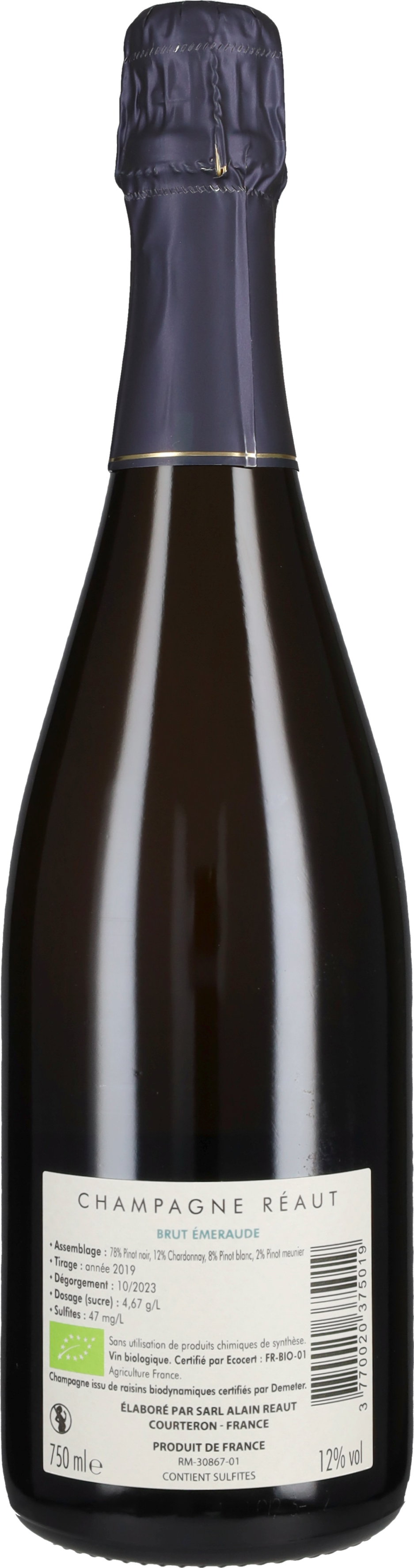
Champagne Réaut Champagne Brut 'Emeraude' Champagne ReautThe Champagne Brut “Emeraude” by Champagne Réaut originates in Courteron in the Aube, at the borders of the renowned Champagne Region. The winery is family-run and involves not only Alain Reaut but also his wife Thérèse and their children Laure and Alexander, the former an international environmental law student and the latter already engaged in the family business after a six-month internship in Australia. Alain learned from two great Champagne experts, Jean-Pierre Fleury and Eric Schreiber, who shared with him their knowledge regarding the principles of biodynamic agriculture for a refined and quality final product. Today, the “three musketeers” cultivate the grapes together on 30 hectares of land and then market them separately, each under their own brand. The Pinot Noir, Chardonnay, Pinot Blanc, and Pinot Meunier grapes of the Champagne Brut “Emeraude” by Champagne Réaut are entirely cultivated following the principles of biodynamic agriculture.with the aim of constantly improving to achieve an authentic taste in the final product, monitoring year after year the changes both in the vineyard and in the evolution of the wine in the bottle. The soil is mainly composed of clay, limestone, and marl for wines with a strong character; excellent drainage of the soil ensures the collection of excess water for the right humidity of the soil. There is good sun exposure throughout the year for complete ripening of the grapes. The grapes are harvested by hand, and the alcoholic fermentation takes place in steel tanks and wooden barrels; it undergoes secondary fermentation in the bottle according to the principles of the Champenoise Method.calls for sip after sip. It pairs well with dishes based on shellfish and mollusks, crispy fried fish; it is also interesting with aged cow and sheep milk cheeses. Perfect for formal aperitifs during business gatherings, but also to celebrate important occasions with family, enjoying a wine with authentic and genuine aromas in the glass.57,00 £*Shipping: 48,00 £Secure redirect to the provider
-
Do D/D/D monsters count as D/D monsters?
Yes, D/D/D monsters do count as D/D monsters. D/D/D monsters are a subgroup within the larger D/D archetype, so they share the same naming convention and are considered part of the D/D family. This means that cards or effects that specifically refer to D/D monsters would also apply to D/D/D monsters. **
-
Can champagne go bad?
Yes, champagne can go bad if it is not stored properly. Exposure to light, heat, or fluctuations in temperature can cause champagne to spoil. Additionally, if the cork is not sealed tightly or if the bottle is stored upright, the champagne can oxidize and lose its flavor. It is best to store champagne in a cool, dark place on its side to keep it fresh for longer. **
-
What percentage is the champagne glass on the left filled, when the champagne...
The champagne glass on the left is filled to approximately 60% when the champagne is poured to the level shown in the image. This estimation is based on the visual representation of the glass and the amount of champagne in it. The glass appears to be filled just over halfway, indicating that it is around 60% full. **
-
Which champagne is the sweetest?
The sweetest type of champagne is typically labeled as "demi-sec." Demi-sec champagnes have a higher sugar content compared to other varieties like brut or extra brut. These champagnes are known for their sweeter taste profile, making them a popular choice for those who prefer a dessert-like champagne. **
* All prices are inclusive of VAT and, if applicable, plus shipping costs. The offer information is based on the details provided by the respective shop and is updated through automated processes. Real-time updates do not occur, so deviations can occur in individual cases. ** Note: Parts of this content were created by AI.